Swachh Bharat, Humari Pehchaan

हर कदम, हर घर, हो साफ़-सफाई,
स्वच्छता से बनेगी जीवन में चमकाई।
स्वभाव हो स्वच्छ, संस्कार सजीले,
हर हाथ बढ़े, बनें हम कर्ता धनीले।

गांव-शहर हो स्वच्छता का प्रतीक,
स्वच्छ भारत का सपना, अब नहीं है अतीत।
मिल-जुल कर चलो, बढ़ाओ ये कारवां,
स्वच्छता हो हमारी पहचान और अभिमान।

कचरे में छुपे हों नए खज़ाने,
वेस्ट से वेल्थ बनाएं, ये सपने सजाने।
स्वच्छ भारत, हर दिल की आवाज़,
बने हमारा राष्ट्र, स्वच्छता में बेमिसाल।

Description

This poem, “Swachh Bharat, Humari Pehchaan,” celebrates the spirit of collective responsibility in creating a cleaner India. It calls for individual action and emphasizes the role of community in upholding cleanliness as a cultural value. The poem also reflects on the transformation of waste into wealth, aligning with the goals of the Swachh Bharat Mission and the idea that cleanliness is not just a task but an identity for every citizen.

Poshan Ki Kahani

बच्चों की हंसी, बुजुर्गों की उमंग,
पोषण में छिपा है जीवन का संग।
साग-सब्ज़ी, दाल और अनाज,
संतुलित आहार हो, स्वस्थ समाज।

माँ की ममता में पोषण का प्यार,
खाने से आती है जीवन में बहार।
दूध, फल और अंकुरित दाने,
सपनों को सच करने के हैं बहाने।

हर निवाले में सेहत की आस,
पोषण हो जीवन की नींव का खास।
स्वस्थ रहेंगे जब हर जन,
देश का होगा उज्ज्वल भविष्य तब।

Description

This poem, “Poshan Ki Kahani,” emphasizes the vital role of nutrition in fostering a healthy and prosperous society. It highlights the importance of a balanced diet, including vegetables, pulses, grains, and fruits, essential for the well-being of all age groups. Through simple, rhythmic lines, the poem conveys the message that proper nutrition leads to physical health, happiness, and a brighter future for the nation. It underlines that nutrition is the foundation of life, nurturing both children and elders alike, ultimately contributing to the country’s progress.

Industrial Relations within the Context of Indian Organizations: An Individual Perspective

Industrial Relations within the Context of Indian Organizations: An Individual Perspective

In the evolving landscape of Indian industrial relations (IR), the relationship between employers, employees, and the government has undergone significant changes. With recent legislative amendments and notable court rulings, IR in India has become more dynamic, reflecting broader economic and social transformations. This article examines the current state of IR in Indian organizations, focusing on recent events, impactful legal cases, and legislative changes that have shaped the landscape.

Recent Legislative Changes

The introduction of the four labor codes by the Indian government is one of the most significant recent developments in IR. The four codes—namely, the Code on Wages, the Industrial Relations Code, the Occupational Safety, Health and Working Conditions Code, and the Social Security Code—aim to simplify and consolidate India’s complex labor laws.

Industrial Relations Code, 2020: This code is particularly relevant as it brings substantial changes to the IR framework. It introduces provisions such as the recognition of trade unions, the establishment of a grievance redressal committee in every industrial establishment, and the requirement for a 60-day notice before strikes and lockouts. These changes aim to balance the power dynamics between employers and employees, fostering a more structured approach to dispute resolution.

Impactful Legal Cases

Recent court rulings have also played a crucial role in shaping the IR landscape. A notable case is the Maruti Suzuki Workers’ Union Case (2012-2022). This prolonged legal battle highlighted the complexities of union recognition and the rights of contract workers. The Supreme Court’s ruling emphasized the need for fair treatment of contract workers, underlining that they should be given similar rights as permanent workers if they perform the same tasks. This case has set a precedent, making it more difficult for employers to exploit contractual loopholes to deny workers their rightful benefits.

Another critical case is the Jet Airways Employee Layoff Case (2020-2021), which brought to the forefront the issue of employee rights during financial crises. The National Company Law Tribunal (NCLT) ruled that while companies facing insolvency have the right to lay off employees, they must follow due process and ensure that layoffs are done fairly, with adequate compensation. This ruling has reinforced the need for transparency and fairness in handling layoffs, especially during economic downturns.

Classroom Cases and Their Implications

Classroom discussions on IR often draw upon real-world cases to illustrate the challenges and opportunities in managing industrial relations. One such case is the Infosys Whistleblower Incident (2019), where allegations of unethical practices by top management led to a broader discussion on corporate governance and employee rights. The incident highlighted the importance of having robust whistleblower policies and ensuring that employees feel safe to raise concerns without fear of retaliation. This case has become a reference point in management education, emphasizing the need for ethical leadership and transparent communication channels within organizations.

Conclusion

The landscape of industrial relations in India is rapidly evolving, influenced by recent legislative changes, landmark court rulings, and significant real-world cases. The introduction of the labor codes marks a shift towards a more structured and equitable framework for managing industrial relations. However, the true impact of these changes will depend on their implementation and how organizations adapt to them.

The legal cases discussed above demonstrate the judiciary’s role in protecting employee rights and ensuring that industrial relations practices align with the principles of fairness and justice. As Indian organizations navigate this complex terrain, the lessons learned from these cases will be crucial in shaping future IR strategies.

Sources:

  1. Ministry of Labour and Employment, Government of India. (2020). The Industrial Relations Code, 2020.
  2. Supreme Court of India. (2022). Maruti Suzuki Workers’ Union Case.
  3. National Company Law Tribunal. (2021). Jet Airways Employee Layoff Case.
  4. Infosys Limited. (2019). Whistleblower Policy and Incident Report.

The Indian Start-up Ecosystem: A Venture Capitalist/Angel Investor’s Perspective

In the past decade, India’s start-up ecosystem has experienced exponential development, resulting in its status as the third-largest in the world, trailing only the United States and China. Indian entrepreneurs are propelling innovation across sectors, from fintech to health-tech. Nevertheless, the road to success is paved with obstacles, and angel investors or venture capitalists (VCs) must navigate it with a balanced approach of foresight and risk.

  1. Key Challenges Faced by Indian Start-ups
  1. Capital Accessibility: Accessing adequate capital continues to be a significant challenge, despite the increasing number of businesses. The high risk and unverified business models of early-stage ventures make it difficult for them to secure funding. Additionally, entrepreneurs are frequently required to generate returns within a relatively brief timeframe, as angel investors and VCs frequently require scalability and swift growth.
  • Regulatory and Compliance Complexities: The regulatory environment in India can be a complex conundrum for entrepreneurs. Entrepreneurs may encounter obstacles such as bureaucratic obstacles, intricate tax structures, and ambiguous legal frameworks for emerging technologies such as blockchain or AI. Additionally, the operations of sectors such as fintech, e-commerce, and agri-tech are further complicated by the additional layers of regulations.

  • Talent Acquisition and Retention: There is an issue with talent in the Indian start-up ecosystem. Skilled professionals frequently favour the job security and benefits provided by larger, more established organisations. Furthermore, it is still difficult to identify individuals who possess proficiency in specialised disciplines, including artificial intelligence (AI), machine learning, and deep technology. In the face of competition from global tech titans, start-ups encounter difficulties in both attracting and retaining talent.

  • Market Penetration and Scalability: India is a particularly difficult market to navigate due to its diverse consumer base. The success of a start-up in a Tier 1 city may not be able to be replicated in Tier 2 or 3 cities due to differences in infrastructure, digital penetration, and spending capacity. This heterogeneity can restrict the scalability of firms, a critical factor for venture capitalists seeking high-growth investments.

  • Investor Sentiment and Economic Volatility: The availability of venture capital can be influenced by macroeconomic factors, such as inflation, global economic slowdowns, or currency fluctuations, which can result in reduced investor confidence. For instance, the pandemic temporarily diminished funding activity, causing a shift in emphasis to businesses that offer essential services and have resilient, scalable models.

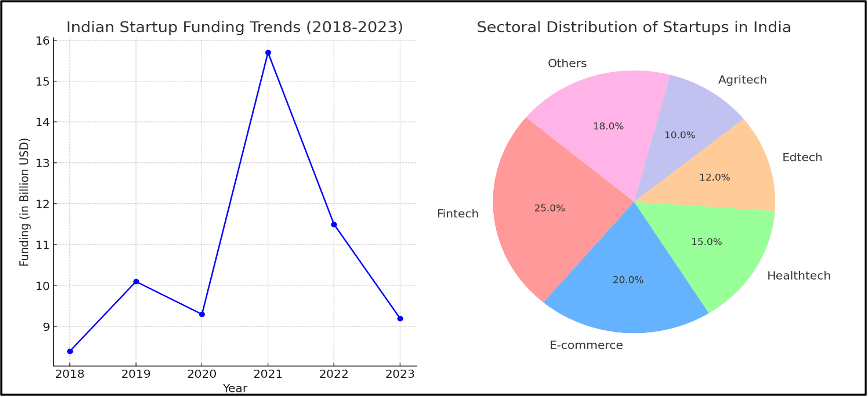
To improve the clarification of the findings, the following are two visual aids:

Indian Startup Funding Trends (2018-2023): The line graph below demonstrates the erratic funding trends of Indian businesses, with significant peaks in 2021 and a subsequent minor decline as a result of global economic conditions.

Sectoral Distribution of Start-ups in India: This pie chart illustrates the distribution of start-ups across critical sectors, with fintech and e-commerce emerging as the most prominent, followed by health-tech, edtech, and agri-tech.

These graphics offer a more comprehensive comprehension of the sectoral focus and funding landscape within the Indian start-up ecosystem.

  • Initiatives Addressing Challenges
  1. Start-up India Initiative: The Start-up India Initiative, which was initiated by the Government of India in 2016, provides tax exemptions, simplified patent registration procedures, and access to government-backed funds to encourage entrepreneurship. The initiative has facilitated the establishment of more than 50,000 companies in a variety of sectors and facilitates the regulatory process.
  • Venture Capital and Angel Tax Reforms: In recent years, there have been substantial tax reforms, particularly in the context of angel tax. The government has promoted increased investment in early-stage ventures by reducing the tax burden on angel investors and relaxing tax exemptions for entrepreneurs. This reform renders India a more appealing destination for high-net-worth individuals and venture capitalists who are interested in investing in enterprises.

  • Enhanced Concentration on Innovation and Deep Tech: The development of technology-driven enterprises is promoted by programs such as the Atal Innovation Mission (AIM) and NASSCOM’s Deep Tech Club. AIM promotes innovation in rural areas and educational institutions by providing businesses with access to incubators, grants, and mentorship, thereby facilitating scalability and long-term sustainability.

  • Assistance from Global Venture Capital Firms: India has experienced a significant increase in investment from global venture capital firms, including SoftBank, Tiger Global, and Sequoia Capital. These firms provide Indian businesses with the opportunity to rapidly scale and investigate international markets by bringing a plethora of expertise, mentorship, and global networks, in addition to capital.

  • Initiatives at the state level: Karnataka, Maharashtra, and Telangana have also instituted state-specific initiatives to support local businesses. For instance, Karnataka’s Elevate 100 initiative annually identifies and supports 100 of the most innovative businesses by offering technical assistance, mentorship, and funding.
  • Other Aspects of the Indian Start-up Ecosystem
  1. Inclusion and Diversity: In the Indian start-up sector, there is a growing emphasis on the promotion of diversity, particularly in the context of women entrepreneurs and social enterprises. Inclusivity is fostered by initiatives such as Women Start-up India and dedicated funding programs for female entrepreneurs. VCs are now focussing more on gender-diverse teams due to research indicating that these teams outperform their counterparts in the long term.

  2. Sectoral Transitions: Although traditional sectors such as fintech and e-commerce have received a significant amount of early funding, newer areas such as agri-tech, health-tech, and edtech are gaining momentum. The pandemic has significantly accelerated the development of health-tech and edtech, as investors have been particularly attentive to start-ups that are utilising digital platforms to address critical gaps in healthcare delivery and education.

  3. The Emergence of Sustainable and Social Impact Start-ups: The demand for impact investment in India is on the rise as a result of the growing awareness of social issues and climate change. Start-ups that prioritise sustainable practices, renewable energy, and rural development are experiencing growth. Investors are acknowledging the long-term sustainability of enterprises that integrate profit with social responsibility.

  4. Initial Public Offering (IPO) Environment: Several Indian firms, such as Nykaa, Paytm, and Zomato, have effectively gone public, indicating the ecosystem’s maturation. The transition from private to public status not only offers VCs an exit strategy but also enhances the credibility of the Indian start-up scene.


Conclusion

India’s start-up ecosystem presents an enormous opportunity from the perspective of venture capitalists and angel investors. Nevertheless, regulatory complexities, talent acquisition, and access to capital necessitate meticulous management. The Indian market has become a hotbed of innovation as a result of the influx of global capital and the initiatives taken by the Indian government, which have substantially mitigated these challenges.

The critical factor for investors is the identification of ventures that possess adaptability, scalability, and robust business models. In order to unleash the next surge of entrepreneurial success, it will be essential to concentrate on sectors such as deep tech, health-tech, and social impact businesses as the ecosystem continues to evolve.

References

  1. Ministry of Commerce and Industry, Government of India. (2023). Startup India Initiative.
  2. NASSCOM. (2023). DeepTech Club.
  3. Invest India. (2023). State-level Startup Initiatives.
  4. Sequoia India. (2023). Investing in India’s Innovation.

Tech-Savvy Strategies: Marketing in the Age of Innovation

In the modern era, marketing has evolved from traditional billboard advertisements and television commercials to a digital-first approach, where online platforms, social media, and data-driven strategies take center stage. Technology has reshaped the way businesses engage with customers, craft their messages, and deliver value. As the age of innovation continues to unfold, businesses must adopt tech-savvy strategies to stay relevant and competitive in a rapidly changing marketplace.

The Rise of Digital Marketing

The emergence of the internet revolutionized marketing, introducing a myriad of platforms and tools that were unimaginable just a few decades ago. Digital marketing has become the backbone of modern marketing strategies, enabling brands to reach global audiences at a fraction of the cost of traditional methods.

Search engines, social media platforms, and e-commerce websites are now critical channels through which businesses connect with consumers. Google, Facebook, Instagram, and other tech giants have given marketers access to detailed insights into consumer behavior, allowing them to tailor campaigns with unprecedented precision.

Online Platforms: The New Marketplaces

In the age of innovation, online platforms have become the primary battleground for customer attention. Websites, blogs, and e-commerce platforms are vital for brand visibility. An online presence is no longer optional—it’s an expectation. Companies like Amazon, for example, dominate the global retail landscape by providing seamless digital experiences that meet the needs of modern consumers.

Brands that fail to invest in robust online platforms risk losing out to competitors who understand the importance of optimizing user experiences and maintaining a strong digital presence. Websites that are optimized for mobile devices, offer personalized content, and incorporate effective SEO strategies help businesses stand out in crowded digital environments.

The Role of Social Media in Marketing

Social media has evolved from a mere communication tool into a powerful marketing channel. With platforms like Facebook, Instagram, LinkedIn, and TikTok, businesses now have direct access to billions of potential customers. The impact of social media on marketing cannot be overstated, as it allows brands to engage directly with their audience, build communities, and foster loyalty.

One of the most significant changes social media has brought is the ability to humanize brands. Instead of being faceless entities, companies now interact with customers through personalized messages, live sessions, and content that resonates emotionally with users. Brand storytelling, in particular, thrives on platforms like Instagram and TikTok, where visual content can spark emotional connections with the audience.

Moreover, influencers and user-generated content (UGC) have emerged as powerful tools in marketing strategies. By collaborating with influencers who share similar values, businesses can reach niche audiences and build trust organically. UGC, where customers share their experiences with a product or service, further validates a brand’s credibility, often leading to increased sales and customer loyalty.

Data-Driven Marketing: The Key to Personalization

Technology has not only provided new platforms for marketing but also the means to gather, analyze, and utilize vast amounts of data. Data-driven marketing has transformed the way businesses craft their strategies, enabling highly personalized and targeted campaigns.

With the rise of big data, machine learning, and artificial intelligence, marketers can now collect and analyze customer information to gain insights into preferences, behaviors, and trends. Tools like Google Analytics, customer relationship management (CRM) systems, and marketing automation platforms enable businesses to track user interactions and optimize their marketing efforts.

Personalization and Targeting

One of the most significant advantages of data-driven marketing is the ability to create personalized experiences. Consumers today expect brands to deliver tailored content and offers based on their preferences. Personalized emails, product recommendations, and targeted ads have become standard in digital marketing strategies.

For instance, e-commerce giants like Amazon and Netflix use data to recommend products and content to users based on their previous interactions. This level of personalization increases customer satisfaction and boosts conversion rates, as consumers are more likely to engage with content that is relevant to their needs.

Predictive Analytics

Beyond personalization, data-driven marketing also involves predictive analytics, where brands use historical data to forecast future trends and behaviors. This allows businesses to make informed decisions, optimize campaigns, and allocate resources more efficiently.

Predictive analytics tools can help marketers identify which leads are more likely to convert, which products are gaining traction, and how customers might respond to future marketing efforts. This proactive approach enables businesses to stay ahead of the competition and adapt to market changes with agility.

The Impact of Automation and AI

Automation and artificial intelligence (AI) are driving forces behind many of the technological advancements in marketing. Marketing automation tools streamline processes such as email marketing, social media scheduling, and lead nurturing, allowing businesses to execute campaigns more efficiently.

AI, on the other hand, is revolutionizing how marketers interact with customers. Chatbots, for example, provide instant customer service, answering queries and guiding users through the buying process in real-time. AI-powered chatbots can engage with customers 24/7, offering personalized assistance based on user data.

Moreover, AI algorithms can analyze vast datasets to uncover hidden patterns and trends, allowing marketers to optimize campaigns with data-driven insights. Programmatic advertising, where AI is used to automate the buying and placement of ads, has become a game-changer in digital marketing. This technology allows marketers to target specific audiences in real-time, improving ad efficiency and maximizing return on investment (ROI).

The Importance of Omni-Channel Marketing

While individual platforms and technologies are essential, the most successful marketing strategies in the age of innovation adopt an omni-channel approach. Omni-channel marketing focuses on providing a seamless customer experience across multiple touchpoints—online and offline. Whether a customer interacts with a brand on social media, visits its website, or walks into a physical store, the experience should be cohesive and consistent.

Omni-channel marketing acknowledges that customers often move between different platforms and devices throughout their buying journey. A customer might discover a product on Instagram, read reviews on a website, and then make a purchase via a mobile app.

Businesses that ensure a smooth transition between these interactions are more likely to retain customers and encourage repeat business.

Integrating Digital and Physical Experiences

One of the key challenges and opportunities for businesses is integrating digital and physical experiences. Retailers, for example, can use technology to bridge the gap between online and offline shopping. Augmented reality (AR) and virtual reality (VR) are increasingly being used to enhance customer experiences, enabling users to virtually try on products or visualize how they would look in their homes.

Additionally, tools like location-based marketing allow businesses to send personalized offers to customers when they are near a physical store, further enhancing the omni-channel experience.

Conclusion

The rapid pace of technological advancement has fundamentally transformed the marketing landscape. From digital platforms to social media, data-driven insights, and AI-powered automation, the age of innovation has introduced numerous opportunities for businesses to connect with their audiences in meaningful ways.

As marketing continues to evolve, businesses must remain agile and adopt tech-savvy strategies that harness the power of these innovations. The future of marketing lies in personalization, automation, and an integrated omni-channel approach, where technology and human connection intersect to deliver exceptional customer experiences. Businesses that embrace these strategies will be well-positioned to thrive in the digital age.

Balancing Innovation and Risk: Managing Fintech Partnerships in the Modern Banking Ecosystem

The financial services industry is undergoing a radical transformation as technological advancements continue to reshape the banking landscape. Traditional banks are increasingly forming partnerships with fintech companies to enhance their product offerings, improve customer experience, and stay competitive in a fast-evolving market. However, while these collaborations offer significant opportunities for innovation, they also introduce new risks that banks must carefully manage. Striking the right balance between embracing fintech-driven innovation and mitigating potential risks is crucial for the success and sustainability of these partnerships in the modern banking ecosystem.

The Rise of Fintech Partnerships in Banking

In recent years, fintech companies have emerged as disruptive forces in the financial services sector, offering innovative solutions such as digital payments, peer-to-peer lending, robo-advisory services, and blockchain-based platforms. Unlike traditional banks, fintechs are agile, often leveraging cutting-edge technology to provide customers with faster, more convenient services at lower costs. To compete in this new environment, banks have increasingly turned to fintech partnerships to enhance their service offerings and accelerate their digital transformation efforts.

These partnerships allow banks to integrate fintech solutions into their operations, providing customers with a seamless and innovative banking experience. By collaborating with fintechs, traditional banks can access specialized technologies that may be too costly or time-consuming to develop in-house. For example, a bank may partner with a fintech company to offer digital wallets, streamline loan approval processes, or implement artificial intelligence (AI) for personalized financial advice.

The Benefits of Fintech Partnerships

Improved Customer Experience: One of the primary advantages of fintech partnerships is the ability to offer enhanced customer experiences. Fintechs specialize in creating user-friendly, digital-first solutions that cater to the needs of tech-savvy consumers. Through collaboration, banks can provide faster, more efficient services, such as real-time payments, mobile banking apps, and automated financial planning tools.

Increased Operational Efficiency: Fintech companies often bring technological expertise that can streamline banking operations, leading to reduced costs and increased efficiency. For example, automation tools powered by AI and machine learning can simplify complex processes such as fraud detection, compliance monitoring, and risk assessment.

Access to New Markets: Fintech partnerships can help banks tap into underserved or niche markets that they may not have been able to reach on their own. For example, by working with fintechs that focus on financial inclusion, banks can expand their customer base by offering services to individuals who may not have access to traditional banking products.

Innovation and Agility: The collaboration between banks and fintechs fosters innovation by combining the strengths of both entities. Banks bring regulatory knowledge, established infrastructure, and a large customer base, while fintechs contribute agility, technological innovation, and a deep understanding of emerging trends. This combination allows for the rapid development of new financial products and services that can keep pace with changing consumer expectations.

The Risks of Fintech Partnerships

While the benefits of fintech partnerships are undeniable, these collaborations also introduce a range of risks that banks must carefully manage. From regulatory compliance to cybersecurity threats, the integration of fintech solutions into traditional banking systems can expose institutions to new vulnerabilities.

1. Regulatory and Compliance Risks

The financial industry is one of the most heavily regulated sectors in the world, and banks must adhere to strict compliance requirements to ensure the stability and integrity of the financial system. When partnering with fintech companies, banks must ensure that their fintech collaborators also comply with relevant regulations, such as anti-money laundering (AML) laws, data privacy regulations, and consumer protection rules.

However, fintechs often operate in a less regulated environment compared to traditional banks, which can create compliance challenges. Banks must conduct thorough due diligence on their fintech partners to ensure that they have robust risk management frameworks in place and that their solutions meet regulatory standards. Failure to do so could result in regulatory fines, reputational damage, or even legal action.

2. Cybersecurity Threats

The increasing digitization of financial services has made the banking sector a prime target for cybercriminals. Fintech partnerships can exacerbate this risk, as the integration of third-party fintech solutions into a bank’s existing infrastructure can create new entry points for cyberattacks.

Banks must work closely with their fintech partners to implement robust cybersecurity measures that protect sensitive customer data and prevent unauthorized access to financial systems. This includes conducting regular security audits, monitoring for vulnerabilities, and ensuring that fintech partners adhere to industry-standard security protocols.

3. Operational Risks

Integrating fintech solutions into a bank’s existing systems can be complex, and any disruptions in these systems can have significant operational consequences. For example, if a fintech partner’s technology fails, it could result in service outages, transaction delays, or compromised customer data.

Banks must establish clear service level agreements (SLAs) with their fintech partners to define expectations for system reliability, response times, and issue resolution. Additionally, banks should have contingency plans in place to address potential disruptions and ensure business continuity in the event of a technology failure.

4. Cultural and Strategic Misalignment

Successful fintech partnerships require alignment between the goals, values, and cultures of both the bank and the fintech company. However, traditional banks and fintechs often operate with different priorities and organizational structures, which can lead to strategic misalignment.

Banks tend to prioritize risk management, regulatory compliance, and long-term stability, while fintechs may focus on rapid innovation, agility, and short-term growth.

To mitigate this risk, both parties must establish clear communication channels and work collaboratively to align their objectives. Open dialogue and shared decision-making processes can help bridge the gap between traditional banking practices and fintech-driven innovation.

Managing Fintech Partnerships: Best Practices for Success

Given the complexities and risks associated with fintech partnerships, banks must adopt a strategic approach to managing these collaborations. The following best practices can help banks successfully navigate the challenges and opportunities of fintech partnerships:

1. Thorough Due Diligence

Before entering into a partnership, banks should conduct comprehensive due diligence to assess the fintech’s financial stability, technological capabilities, and compliance with regulatory requirements. This includes reviewing the fintech’s data security measures, risk management frameworks, and track record of performance.

2. Strong Governance Framework

Establishing a robust governance framework is essential for managing fintech partnerships effectively. Banks should create dedicated teams to oversee partnership management, including risk assessment, compliance monitoring, and performance evaluation. Clear roles and responsibilities should be defined to ensure that both parties are accountable for their contributions to the partnership.

3. Ongoing Risk Monitoring

Fintech partnerships require continuous monitoring to identify and mitigate risks as they arise. Banks should implement regular risk assessments, conduct security audits, and stay updated on regulatory changes that may impact the partnership. By actively monitoring risk, banks can respond to issues proactively and minimize potential disruptions.

4. Collaboration and Knowledge Sharing

Successful fintech partnerships depend on open communication and collaboration between both parties. Banks and fintechs should work together to share insights, leverage each other’s strengths, and co-create solutions that benefit both the institution and its customers. Establishing regular touchpoints for knowledge sharing and joint innovation initiatives can foster a collaborative environment.

Conclusion

Fintech partnerships represent a powerful opportunity for banks to innovate, improve customer experiences, and stay competitive in an increasingly digital world. However, these collaborations also introduce new risks that must be carefully managed. By adopting best practices such as thorough due diligence, strong governance, and ongoing risk monitoring, banks can strike a balance between embracing fintech-driven innovation and mitigating potential risks. Ultimately, successful fintech partnerships will enable banks to thrive in the modern banking ecosystem while delivering value to their customers.

Crafting Business Sustainability Strategies Using Empathy and Ideation in Design Thinking

Sustainability has become a critical focal point for businesses globally. As industries face mounting pressure to address environmental and social challenges, there is a growing need for innovative strategies that promote long-term sustainability. One powerful approach to achieving this is through the application of design thinking—a human-centered, problem-solving methodology that emphasizes empathy, creativity, and collaboration. By leveraging empathy and ideation, two core pillars of design thinking, businesses can craft sustainability strategies that are not only innovative but also deeply aligned with the needs and values of stakeholders.

In this article, we will explore how empathy and ideation in design thinking can be utilized to develop effective and sustainable business strategies, leading to positive environmental, social, and economic outcomes.

Understanding Design Thinking

Design thinking is a process rooted in creativity and innovation, often used by designers to solve complex problems. However, it has expanded beyond design disciplines and is now widely adopted across various industries to develop products, services, and strategies. The process follows five key stages: empathize, define, ideate, prototype, and test.

Among these stages, empathy and ideation are particularly crucial for crafting sustainability strategies. Empathy ensures that solutions are aligned with the human experience, while ideation fosters the generation of creative solutions to complex challenges.

Empathy: The Foundation of Human-Centered Sustainability

Empathy in design thinking involves deeply understanding the needs, emotions, and perspectives of users or stakeholders. When applied to sustainability, empathy becomes a powerful tool for businesses to connect with the communities they serve, as well as the environment and ecosystems they impact.

Empathy for Stakeholders

A successful sustainability strategy requires a deep understanding of the diverse stakeholders involved, including customers, employees, investors, and communities.

By empathizing with these groups, businesses can identify the sustainability concerns that matter most to them. For example, consumers today are increasingly demanding ethical and eco-friendly products. Through empathy, businesses can discover the underlying motivations behind these demands, such as a desire for transparency in sourcing materials or the need to reduce carbon footprints.

A business that uses empathy as a foundation for sustainability will create strategies that resonate on a human level. This could lead to adopting ethical sourcing practices, reducing waste, or offering eco-friendly packaging—all of which respond to the concerns and values of the customer base.

Empathy for the Environment

In addition to understanding human stakeholders, businesses must also empathize with the environment and recognize their impact on the planet’s resources. This requires a systems-thinking approach, where businesses consider the long-term effects of their actions on natural ecosystems. For instance, industries dependent on raw materials should consider how their extraction and use affect biodiversity, water quality, and climate change.

Through empathy for the environment, businesses can make decisions that prioritize regenerative practices, such as reducing emissions, conserving water, and adopting circular economy principles. The result is a sustainability strategy that not only minimizes harm but actively contributes to environmental restoration.

Ideation: Generating Innovative Sustainability Solutions

Once empathy has been established, the next step in design thinking is ideation—the process of generating creative and often unconventional ideas to solve the identified problems. For sustainability strategies, ideation encourages businesses to think beyond the status quo and explore new, innovative solutions that address both environmental and social challenges.

Encouraging Collaboration and Cross-Disciplinary Thinking

Ideation thrives in an environment of collaboration and diverse perspectives. When developing sustainability strategies, businesses should involve employees from different departments, as well as external experts, customers, and even competitors.

Cross-disciplinary thinking allows for a wider range of ideas to emerge, leading to more comprehensive and effective sustainability initiatives.

For example, a company working to reduce its plastic waste might collaborate with material scientists to explore alternatives to conventional plastics. Simultaneously, the marketing team could provide insights into consumer preferences for sustainable packaging, while the finance department evaluates the cost implications of implementing new materials.

Prototyping and Experimentation

One of the hallmarks of design thinking is the iterative nature of prototyping and testing. In the context of sustainability, businesses should view their strategies as prototypes that can be refined over time. Rather than aiming for perfection from the start, ideation encourages companies to experiment with different approaches, assess their effectiveness, and adapt based on feedback.

For instance, a company may pilot a zero-waste initiative in a specific region before rolling it out on a larger scale. By testing the initiative in a controlled environment, the business can gather data on its feasibility, cost-effectiveness, and impact on customer satisfaction. Based on these insights, the company can make improvements to the strategy before full-scale implementation.

Integrating Empathy and Ideation for Sustainable Success

When empathy and ideation are integrated into the design thinking process, businesses can develop sustainability strategies that are innovative, actionable, and aligned with stakeholder values. However, for these strategies to succeed, businesses must also commit to a culture of continuous learning and adaptation.

Aligning Business Goals with Sustainability Objectives

A key challenge for businesses is finding the balance between profitability and sustainability. By integrating empathy and ideation into their strategy development, companies can uncover opportunities where business growth and sustainability goals intersect. For example, a company that prioritizes reducing energy consumption can also lower operational costs, leading to increased profitability.

Similarly, investing in sustainable supply chains can enhance brand reputation and customer loyalty, driving long-term growth.

Case Study: Patagonia’s Empathy-Driven Approach

Outdoor apparel company Patagonia is a prime example of how empathy and ideation can drive successful sustainability strategies. Patagonia’s commitment to environmental stewardship is rooted in its deep empathy for nature and its customers, who are passionate about outdoor activities and environmental conservation. The company consistently engages with its stakeholders to understand their values and concerns, which has led to the development of innovative products, such as clothing made from recycled materials and a lifetime repair program for worn-out garments.

Patagonia’s ideation process involves continuous experimentation with sustainable materials, product designs, and business models. The company’s dedication to sustainability has not only contributed to environmental protection but also enhanced its brand loyalty and financial success.

Overcoming Challenges in Implementing Empathy-Driven Strategies

While empathy and ideation provide powerful tools for developing sustainability strategies, businesses may encounter challenges during implementation. Resistance to change, short-term financial pressures, and regulatory barriers are common obstacles that can hinder the adoption of sustainable practices. To overcome these challenges, businesses must cultivate a culture of innovation, where experimentation is encouraged, and failure is viewed as an opportunity to learn and improve.

Additionally, leadership plays a crucial role in driving sustainability initiatives.

Business leaders must champion empathy-driven strategies and foster an environment where employees feel empowered to contribute creative ideas for sustainability.

The Role of Technology in Enhancing Empathy and Ideation

Technology can play a pivotal role in enhancing empathy and ideation for sustainability strategies. Tools such as data analytics, artificial intelligence, and virtual reality can provide valuable insights into customer preferences, environmental impacts, and market trends. For example, AI-driven data analysis can help businesses identify patterns in consumer behavior that inform sustainable product development, while virtual reality simulations can enable companies to visualize the long-term environmental impact of their operations.

Conclusion

Crafting business sustainability strategies using empathy and ideation in design thinking offers a powerful approach to addressing complex environmental and social challenges. By prioritizing the needs and values of stakeholders and embracing creativity and experimentation, businesses can develop strategies that not only drive sustainability but also enhance competitiveness and long-term success.

In today’s rapidly changing world, the integration of empathy and ideation is essential for businesses seeking to thrive while contributing positively to society and the planet. As companies continue to adopt design thinking principles, they will be better equipped to navigate the complexities of sustainability and create a future where business success and environmental stewardship go hand in hand.
NAAC Accreditation: Enhancing Quality in Higher Education Institutions in India

Understand the function of the National Assessment and Accreditation Council (NAAC) in the assessment and enhancement of the quality of higher education institutions in India. Discover its grading system, accreditation process, and influence on academic standards.

The National Assessment and Accreditation Council (NAAC) is instrumental in the preservation of academic standards in India by conducting assessments of higher education institutions. This article offers a thorough explanation of NAAC accreditation, including the grading system, benefits, and significance to universities and institutions.

Introduction

The National Assessment and Accreditation Council (NAAC) is an autonomous entity that performs assessments and accreditations of higher education institutions (HEIs) in India, under the University Grants Commission (UGC). NAAC, which was established in 1994, is dedicated to the advancement of quality education by means of consistent assessments and accreditations. NAAC accreditation is now a critical metric for the reputation of universities and colleges nationwide.

What is NAAC?

NAAC is dedicated to evaluating the quality of education provided by Indian HEIs. Its vision is to encourage institutions to strive toward excellence and continuous improvement, offering students a better learning environment.

NAAC’s Mission and Goals

The main mission of NAAC is to:

  1. Promote quality and excellence in higher education.
  2. Encourage HEIs to develop a system for consistent quality improvement.
  3. Foster accountability and transparency in the education system.
  4. Provide feedback on the institutions’ strengths and areas of improvement.

NAAC Accreditation Process

The accreditation process is a multi-step procedure aimed at assessing the overall quality of an institution in terms of infrastructure, teaching methods, academic output, and governance.

Steps in the NAAC Accreditation Process

The following steps are involved in the NAAC accreditation process:

  1. Institutional Registration: Institutions must register on the NAAC portal.
  2. Self-Study Report (SSR): The institution submits an SSR, documenting its strengths, weaknesses, academic processes, and quality parameters.
  3. Peer Review Visit: A team of NAAC-approved peers visits the institution to verify the information and assess the infrastructure, teaching processes, and more.
  4. Evaluation and Accreditation: Based on the SSR and peer review, NAAC assigns a grade to the institution.

NAAC Grading System

NAAC uses a 7-point grading scale to assess institutions. Grades are awarded based on performance in key areas such as curriculum, teaching-learning practices, research output, and student support.

NAAC Grading Scale

Here’s a breakdown of the grading system:

  • A++ (3.51 – 4.00): Outstanding
  • A+ (3.26 – 3.50): Excellent
  • A (3.01 – 3.25): Very Good
  • B++ (2.76 – 3.00): Good
  • B+ (2.51 – 2.75): Above Average
  • B (2.01 – 2.50): Average
  • C (1.51 – 2.00): Satisfactory
  • D (<1.51): Not Accredited

The grades reflect the overall institutional quality, helping prospective students and stakeholders make informed decisions.

Benefits of NAAC Accreditation

NAAC accreditation offers a wide range of benefits for institutions, students, and the education system as a whole.

Institutional Benefits

  • Enhanced Reputation: NAAC accreditation significantly boosts the reputation of institutions, both nationally and internationally.
  • Funding Opportunities: Accredited institutions are eligible for more government grants and funding.
  • Quality Improvement: The accreditation process helps institutions identify areas for improvement, ensuring continuous quality enhancement.
  • Student Enrolment: Institutions with NAAC accreditation generally attract more students due to the assurance of quality.

Benefits for Students

  • Better Career Prospects: Degrees from NAAC-accredited institutions carry more weight in the job market.
  • Improved Academic Environment: Students benefit from better infrastructure, teaching methods, and academic resources.

Importance of NAAC in Higher Education

NAAC plays a pivotal role in ensuring that institutions uphold high educational standards, which directly impacts India’s global standing in education.

Promoting Accountability

NAAC ensures that institutions remain accountable for their academic processes. Institutions must regularly update their teaching methodologies, research outputs, and administrative procedures to maintain or improve their NAAC rating.

Role in Policy Making

The accreditation data collected by NAAC also aids policymakers in shaping education reforms, enhancing the quality of education at a national level.

Recent Changes in NAAC Policies

NAAC has made several updates to its assessment framework to ensure that it keeps pace with the rapidly changing education landscape. In 2019, NAAC introduced a revised accreditation process, which emphasizes:

  1. Student-centric assessments: Focuses more on student experiences and learning outcomes.
  2. Use of ICT: Leveraging technology for transparent and efficient accreditation.
  3. More frequent assessments: The periodic accreditation cycle has become more stringent, ensuring regular quality checks.

How to Prepare for NAAC Accreditation

Institutions aspiring for NAAC accreditation should focus on maintaining high academic and operational standards.

Key Areas of Focus

  1. Quality Teaching-Learning Practices: Institutions must invest in qualified faculty, updated curricula, and student support services.
  2. Infrastructure: Adequate infrastructure in terms of libraries, laboratories, and classrooms is crucial.
  3. Research Output: NAAC places a strong emphasis on the institution’s research contributions.
  4. Administrative Practices: Efficient governance and student feedback mechanisms contribute to better accreditation results.

FAQs

Q1: Is NAAC accreditation mandatory for colleges in India?

No, NAAC accreditation is not mandatory but is highly encouraged as it adds credibility and enhances the institution’s reputation.

Q2: How long is NAAC accreditation valid?

NAAC accreditation is typically valid for five years, after which the institution must apply for reaccreditation.

Q3: What happens if an institution does not meet the accreditation standards?

Institutions that do not meet the required standards are not accredited. However, they can work on improving their deficiencies and reapply after a certain period.

Conclusion

The process of NAAC accreditation is essential for the improvement of the quality of education in India. It ensures that students receive an education in a well-structured, supportive environment, promotes excellence, and holds institutions accountable. NAAC continues to be a significant influence in the development of higher education in the nation, as it prioritises innovation and implements ongoing reforms.

References:

  1. NAAC Official Website: NAAC – National Assessment and Accreditation Council
  2. UGC Guidelines on NAAC Accreditation: UGC

Title: The Journey of Samosa: From Ancient Delicacy to Modern Snack

Once upon a time, in the bustling streets of ancient Persia, a delicious pastry known as the “samosa” was born. This delectable treat was originally called “sambosa” and was filled with spiced meat and vegetables. The secret to its crispiness lay in a blend of flour, ghee, and a special rolling technique.

As trade routes expanded, the sambosa traveled to India, where it underwent a remarkable transformation. Indian chefs adapted the recipe, infusing it with local spices and ingredients like potatoes, peas, and cumin. The samosa was soon embraced by Indian palates, and its name evolved into the familiar “samosa.”

In the medieval period, the samosa became a popular street food, enjoyed by everyone from kings to commoners. It was often served at festive occasions and as a savory snack during tea time. The samosa’s versatility grew as different regions of India put their own spin on it, creating variations like the spicy “Punjabi samosa” and the sweet “Mysore samosa.”

Fast forward to the modern era, and the samosa has made its mark globally. From food trucks in New York to gourmet restaurants in London, the samosa has become a symbol of culinary fusion and creativity. Today, it’s not just a snack; it’s a cultural icon, representing the rich, diverse heritage of Indian cuisine.

And so, the samosa continues its journey, delighting taste buds around the world, a testament to its enduring legacy and the timeless art of culinary innovation.

Innovative Strategies for Brands to Navigate Public Backlash During Political

Conflicts: The Israel-Gaza Case

In today’s interconnected world, brands are no longer isolated from the socio-political landscapes in which they operate. The Israel-Gaza conflict, a highly sensitive and polarizing issue, serves as a prime example of how brands can find themselves caught in the crossfire of public opinion. With stakeholders demanding transparency, accountability, and action, the traditional strategy of staying neutral or silent is no longer sufficient. Brands must now navigate these turbulent waters with innovative strategies that not only protect their reputation but also demonstrate social responsibility.

Understanding the Risks of Public Backlash

When political conflicts arise, brands are often scrutinized by both sides of the debate. The Israel-Gaza conflict, in particular, has seen a significant rise in public engagement, with consumers, activists, and even employees urging companies to take a stand. The risks of ignoring these calls are substantial, ranging from boycotts and negative media coverage to long-term damage to brand loyalty.

One of the most significant challenges is the polarized nature of the conflict. Taking a stance, or even appearing to take one, can alienate a substantial portion of a brand’s customer base. On the other hand, silence can be perceived as complicity, leading to backlash from those who expect brands to be socially responsible.

Innovative Strategies for Navigating Political Conflicts

Active Listening and Stakeholder Engagement

The first step for brands in navigating political conflicts is to engage in active listening. This involves monitoring social media, news outlets, and direct feedback from stakeholders to understand the various perspectives surrounding the conflict. By actively listening, brands can gauge the sentiment of their audience and identify potential risks before they escalate.

In the context of the Israel-Gaza conflict, active listening can help brands understand the diverse opinions and concerns of their stakeholders. This insight is crucial in crafting a response that is both empathetic and informed. Brands should also engage with stakeholders through open forums, surveys, and discussions, ensuring that their voices are heard and considered in decision-making processes.

Transparent Communication

Transparency is key when navigating political conflicts. Brands should communicate openly about their values, intentions, and actions. This transparency builds trust and can mitigate the impact of any backlash. For instance, if a brand decides to donate to humanitarian efforts in the Israel-Gaza region, it should clearly articulate the rationale behind the decision and how it aligns with the brand’s core values.

A successful example of this is Ben & Jerry’s, which has a long history of taking stands on social justice issues. During the Israel-Gaza conflict, the company openly communicated its decision to cease sales in Israeli settlements, explaining that the move was consistent with its commitment to human rights. While this decision sparked controversy, Ben & Jerry’s transparent communication helped maintain its credibility and align with its brand ethos.

Corporate Social Responsibility (CSR) Initiatives

Brands can also navigate political conflicts by leveraging their CSR initiatives. By supporting humanitarian efforts, promoting peace, and advocating for dialogue, brands can position themselves as forces for good rather than taking sides in the conflict. This approach not only helps in mitigating backlash but also enhances the brand’s image as socially responsible.

For example, during the Israel-Gaza conflict, brands could support organizations working towards peace and reconciliation in the region. This allows the brand to contribute positively without explicitly aligning with one side of the conflict. Such initiatives should be carefully planned and executed, ensuring they are seen as genuine efforts rather than opportunistic gestures.

Internal Policies and Employee Support

Brands must also consider the impact of political conflicts on their internal stakeholders, particularly employees. The Israel-Gaza conflict, like other political issues, can create tension within the workplace, especially in diverse organizations. Brands should implement internal policies that promote respect, inclusion, and support for employees who may be affected by the conflict.

Offering resources such as counseling, open forums for discussion, and clear communication about the company’s stance can help mitigate internal conflict and foster a positive work environment. Additionally, brands should ensure that their actions and public statements align with their internal policies, reinforcing a consistent and principled approach.

Adaptive Crisis Management

In the age of social media, public sentiment can shift rapidly. Brands must be prepared to adapt their strategies in real time to address emerging issues. This requires a robust crisis management plan that includes monitoring tools, clear communication protocols, and a dedicated crisis response team.

During the Israel-Gaza conflict, for example, brands should be ready to respond swiftly to any negative press or social media backlash. This could involve issuing statements, providing updates on CSR efforts, or adjusting marketing campaigns to reflect the evolving situation.

An adaptive approach allows brands to stay ahead of the narrative and maintain control over their messaging.

Conclusion

Navigating the complexities of political conflicts like the Israel-Gaza situation requires brands to move beyond traditional strategies of neutrality. In an era where stakeholders expect more from companies, innovative strategies that emphasize active listening, transparent communication, CSR initiatives, internal policies, and adaptive crisis management are essential.

By adopting these approaches, brands can not only protect their reputation but also contribute positively to the discourse. The key is to remain authentic, empathetic, and responsive, ensuring that the brand’s actions align with its values and the expectations of its stakeholders.

References

  1. McKinsey & Company. (2021). “Brand Management in the Age of Political Polarization.” Retrieved from McKinsey.com.
  • Harvard Business Review. (2022). “Navigating Corporate Social Responsibility in Conflict Zones.” Retrieved from hbr.org.
  • The Guardian. (2021). “How Brands Can Survive Public Backlash During Political Crises.” Retrieved from theguardian.com.