In the past decade, India’s start-up ecosystem has experienced exponential development, resulting in its status as the third-largest in the world, trailing only the United States and China. Indian entrepreneurs are propelling innovation across sectors, from fintech to health-tech. Nevertheless, the road to success is paved with obstacles, and angel investors or venture capitalists (VCs) must navigate it with a balanced approach of foresight and risk.
- Key Challenges Faced by Indian Start-ups
- Capital Accessibility: Accessing adequate capital continues to be a significant challenge, despite the increasing number of businesses. The high risk and unverified business models of early-stage ventures make it difficult for them to secure funding. Additionally, entrepreneurs are frequently required to generate returns within a relatively brief timeframe, as angel investors and VCs frequently require scalability and swift growth.
- Regulatory and Compliance Complexities: The regulatory environment in India can be a complex conundrum for entrepreneurs. Entrepreneurs may encounter obstacles such as bureaucratic obstacles, intricate tax structures, and ambiguous legal frameworks for emerging technologies such as blockchain or AI. Additionally, the operations of sectors such as fintech, e-commerce, and agri-tech are further complicated by the additional layers of regulations.
- Talent Acquisition and Retention: There is an issue with talent in the Indian start-up ecosystem. Skilled professionals frequently favour the job security and benefits provided by larger, more established organisations. Furthermore, it is still difficult to identify individuals who possess proficiency in specialised disciplines, including artificial intelligence (AI), machine learning, and deep technology. In the face of competition from global tech titans, start-ups encounter difficulties in both attracting and retaining talent.
- Market Penetration and Scalability: India is a particularly difficult market to navigate due to its diverse consumer base. The success of a start-up in a Tier 1 city may not be able to be replicated in Tier 2 or 3 cities due to differences in infrastructure, digital penetration, and spending capacity. This heterogeneity can restrict the scalability of firms, a critical factor for venture capitalists seeking high-growth investments.
- Investor Sentiment and Economic Volatility: The availability of venture capital can be influenced by macroeconomic factors, such as inflation, global economic slowdowns, or currency fluctuations, which can result in reduced investor confidence. For instance, the pandemic temporarily diminished funding activity, causing a shift in emphasis to businesses that offer essential services and have resilient, scalable models.
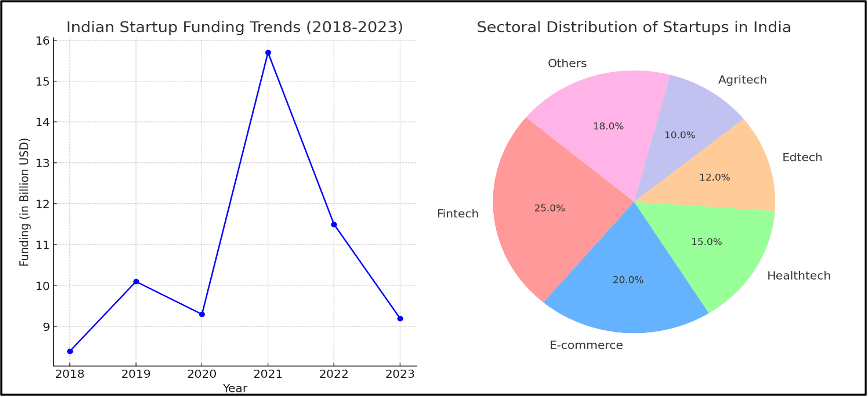
To improve the clarification of the findings, the following are two visual aids:
Indian Startup Funding Trends (2018-2023): The line graph below demonstrates the erratic funding trends of Indian businesses, with significant peaks in 2021 and a subsequent minor decline as a result of global economic conditions.
Sectoral Distribution of Start-ups in India: This pie chart illustrates the distribution of start-ups across critical sectors, with fintech and e-commerce emerging as the most prominent, followed by health-tech, edtech, and agri-tech.
These graphics offer a more comprehensive comprehension of the sectoral focus and funding landscape within the Indian start-up ecosystem.
- Initiatives Addressing Challenges
- Start-up India Initiative: The Start-up India Initiative, which was initiated by the Government of India in 2016, provides tax exemptions, simplified patent registration procedures, and access to government-backed funds to encourage entrepreneurship. The initiative has facilitated the establishment of more than 50,000 companies in a variety of sectors and facilitates the regulatory process.
- Venture Capital and Angel Tax Reforms: In recent years, there have been substantial tax reforms, particularly in the context of angel tax. The government has promoted increased investment in early-stage ventures by reducing the tax burden on angel investors and relaxing tax exemptions for entrepreneurs. This reform renders India a more appealing destination for high-net-worth individuals and venture capitalists who are interested in investing in enterprises.
- Enhanced Concentration on Innovation and Deep Tech: The development of technology-driven enterprises is promoted by programs such as the Atal Innovation Mission (AIM) and NASSCOM’s Deep Tech Club. AIM promotes innovation in rural areas and educational institutions by providing businesses with access to incubators, grants, and mentorship, thereby facilitating scalability and long-term sustainability.
- Assistance from Global Venture Capital Firms: India has experienced a significant increase in investment from global venture capital firms, including SoftBank, Tiger Global, and Sequoia Capital. These firms provide Indian businesses with the opportunity to rapidly scale and investigate international markets by bringing a plethora of expertise, mentorship, and global networks, in addition to capital.
- Initiatives at the state level: Karnataka, Maharashtra, and Telangana have also instituted state-specific initiatives to support local businesses. For instance, Karnataka’s Elevate 100 initiative annually identifies and supports 100 of the most innovative businesses by offering technical assistance, mentorship, and funding.
- Other Aspects of the Indian Start-up Ecosystem
- Inclusion and Diversity: In the Indian start-up sector, there is a growing emphasis on the promotion of diversity, particularly in the context of women entrepreneurs and social enterprises. Inclusivity is fostered by initiatives such as Women Start-up India and dedicated funding programs for female entrepreneurs. VCs are now focussing more on gender-diverse teams due to research indicating that these teams outperform their counterparts in the long term.
- Sectoral Transitions: Although traditional sectors such as fintech and e-commerce have received a significant amount of early funding, newer areas such as agri-tech, health-tech, and edtech are gaining momentum. The pandemic has significantly accelerated the development of health-tech and edtech, as investors have been particularly attentive to start-ups that are utilising digital platforms to address critical gaps in healthcare delivery and education.
- The Emergence of Sustainable and Social Impact Start-ups: The demand for impact investment in India is on the rise as a result of the growing awareness of social issues and climate change. Start-ups that prioritise sustainable practices, renewable energy, and rural development are experiencing growth. Investors are acknowledging the long-term sustainability of enterprises that integrate profit with social responsibility.
- Initial Public Offering (IPO) Environment: Several Indian firms, such as Nykaa, Paytm, and Zomato, have effectively gone public, indicating the ecosystem’s maturation. The transition from private to public status not only offers VCs an exit strategy but also enhances the credibility of the Indian start-up scene.
Conclusion
India’s start-up ecosystem presents an enormous opportunity from the perspective of venture capitalists and angel investors. Nevertheless, regulatory complexities, talent acquisition, and access to capital necessitate meticulous management. The Indian market has become a hotbed of innovation as a result of the influx of global capital and the initiatives taken by the Indian government, which have substantially mitigated these challenges.
The critical factor for investors is the identification of ventures that possess adaptability, scalability, and robust business models. In order to unleash the next surge of entrepreneurial success, it will be essential to concentrate on sectors such as deep tech, health-tech, and social impact businesses as the ecosystem continues to evolve.
References
- Ministry of Commerce and Industry, Government of India. (2023). Startup India Initiative.
- NASSCOM. (2023). DeepTech Club.
- Invest India. (2023). State-level Startup Initiatives.
- Sequoia India. (2023). Investing in India’s Innovation.

 OneVoice